No, SEO isn’t “dead” – but your strategy might be.
Every year, without fail, someone declares SEO dead. And every year, they're wrong.
But in 2026, the question feels more loaded than ever. AI tools are answering questions before you've finished typing them. ChatGPT has become many people's first port of call for information. Google looks and behaves completely differently to how it did five years ago. So it's understandable that business owners are nervous and asking: is any of this still worth it?
The short answer is: yes.
The longer answer is worth your time… and might just change how you think about your brand.
Let’s start at the beginning. What is SEO – really?
Ask most people what SEO is and they might say something about keywords and Google rankings. And yes, those things matter.
But at its heart, SEO has never been purely about gaming an algorithm. Yes, understanding how Google works is part of it. But it's equally about understanding what your audience needs: the questions they're asking, the problems they're trying to solve, and developing a user experience that caters to them.
The brands that have always “won” at SEO are the ones that treated it as a relationship-building exercise, not a technical checklist. Rankings are the output – relevance, trust, originality, and value are the input.
Better yet, Google has its own name for this approach: E-E-A-T (Experience, Expertise, Authoritativeness and Trustworthiness).
It's Google's quality framework for ranking pages and content by asking: does this brand actually know what it's talking about? Can people trust what they're saying? It's not a technical metric you can manufacture. It's a reputation you build over time, through every interaction, every word, and every experience you create for your audience.
Google’s been evolving longer than we think.
The shift toward AI-powered search didn't begin with the ChatGPT boom. Cast your mind back to 2015, when Google introduced featured snippets – those boxes at the top of search results that pull a direct answer from a webpage before you've even clicked a link.
That was Google's first signal that it was moving away from being a plethora of competing links to becoming an answer engine. Shortly after came People Also Ask, clusters of related queries that Google surfaces to help users explore a topic more deeply – each populated with a pulled answer from the most relevant source.
These features gave rise to Answer Engine Optimisation (AEO), a discipline built around structuring content to be the answer, not just rank near it. Good AEO means writing clearly, thinking in questions, and demonstrating expertise.
Sound familiar?
It should – because it's the same instinct as good SEO, just more explicitly focused on answers over links. What feels like a sudden AI revolution in search is actually something Google has been quietly steering toward for years.
So, has AI changed SEO or not?
Significantly, but perhaps not in the way you've been told.
The headlines have been dramatic: Organic traffic down 60%. SEO is finished. AI killed the internet.
But the data tells a different story. A large-scale analysis by Graphite (November 2025), using Similarweb data across more than 40,000 of the largest US websites, found that organic search traffic declined by just 2.5% year over year.
Not 25%. Not 60%.
Google itself reported that total organic click volume was relatively stable year on year. The panic is overblown, but the change is still real, and it's worth understanding exactly where it's being felt.
The click-through truth.
The sharpest declines have hit those whose content is heavily informational. Ahrefs’ February 2026 report found that Google's AI Overviews – the generated summaries that now appear at the top of many search results powered by Gemini – reduce click-through rates by up to 58% for top-ranking pages when they appear…
…but they only appear on around 30% of queries, the majority being informational searches. Commercial and transactional queries, the ones targeting users who are ready to buy, are far less affected.
The Bing factor.
There's another shift worth flagging, and it's one that catches most people off guard: Bing.
Yes… Bing.
The search engine that's been the punchline of the industry for years has quietly become one of the most strategically important platforms in the AI landscape. ChatGPT's web browsing and search functionality is powered by Bing's index. Perplexity and other AI tools draw from it too. Which means if your brand has neglected Bing – and, let’s be honest, most have – you could be a ghost in the AI machine.
AI is the opportunity, not the threat.
Here's where the conversation around AI search needs to shift – from fear to strategy.
Traditional SEO is not going anywhere. Organic search still accounts for roughly 90% of search clicks versus paid, and the fundamentals: quality content, domain authority, technical health, genuine relevance – still underpin how you rank, how you're found, and how you're trusted.
But alongside it, a new channel has opened up. ChatGPT, Perplexity, Gemini, Google's own AI Overviews are now a primary knowledge source for millions of people, and the brands already building a presence in AI search are pulling ahead. The ones appearing in those responses, cited, referenced, recommended, are the ones setting the standard for digital visibility.
That's where Generative Engine Optimisation (GEO) comes in – the discipline of ensuring your brand, content and expertise are visible and credible within AI-generated responses. It's the natural evolution of AEO, the same instinct to be the answer, now applied to a world where the answer is synthesised by an LLM rather than extracted from a single page.
Before you chase the algorithm…
But before you ask "how do I get ChatGPT to mention me?"... pause. That's the wrong first question.
The right question is: what do you want ChatGPT to say about you?
Because appearing in an AI response matters very little if the narrative is wrong, vague, or forgettable. Brand clarity comes before optimisation. Knowing your story, your authority, your point of difference – that's what shapes how LLMs represent you. And that work is every bit as much about content and brand as it is about technical SEO.
What should your SEO strategy look like in 2026?
Ready for the good news? The foundations of effective SEO and effective GEO are the same:
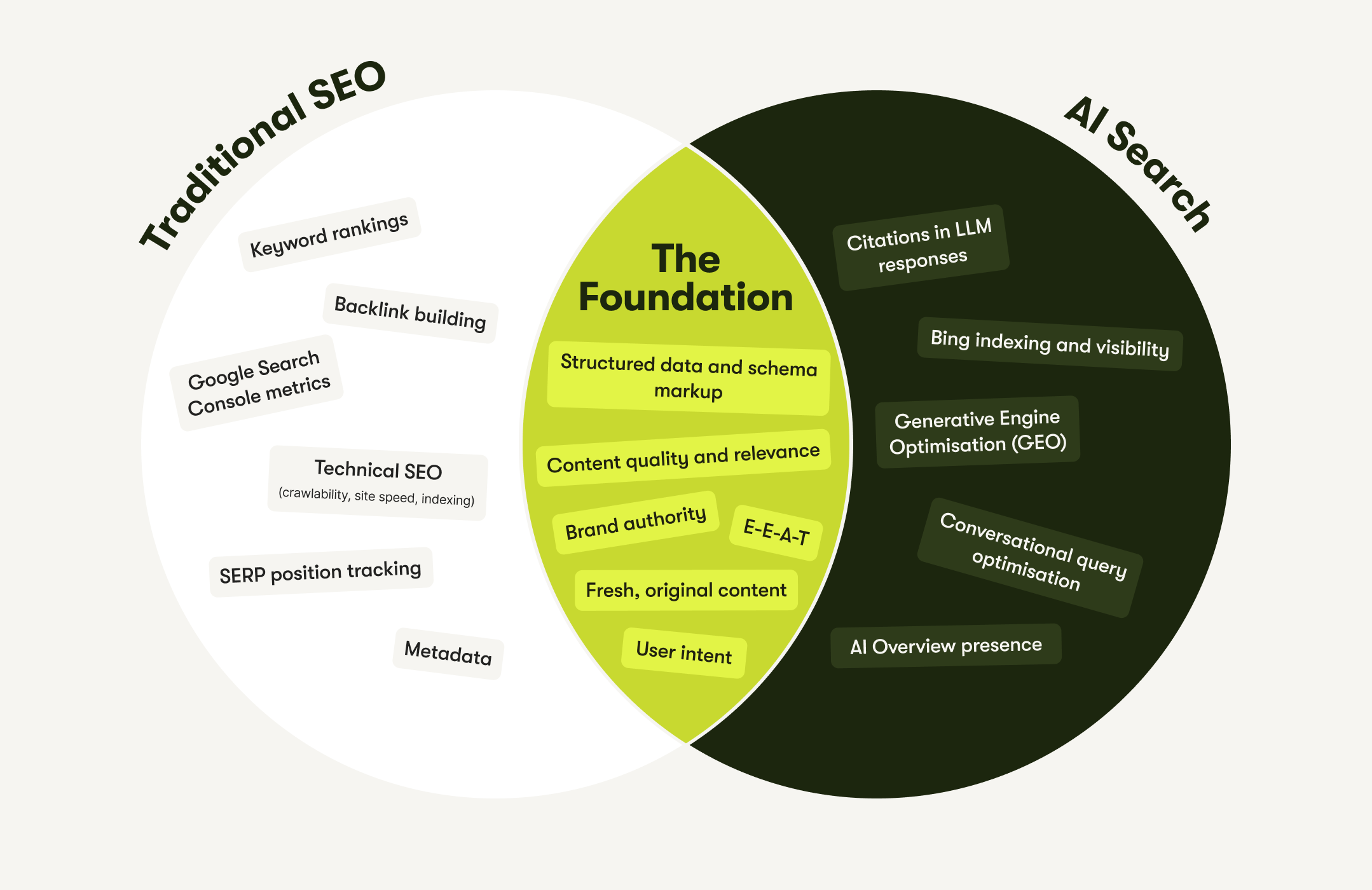
Content quality, E-E-A-T, user intent, structured data, brand authority are the things that make you rank on Google and the things that make LLMs trust and cite you. The investment you've already made in good SEO isn't wasted. It's the platform everything else is built on.
What's new is the layer on top. AI search requires you to think about conversational queries, Bing visibility, citation signals, and how your content reads to a generative model that's synthesising across multiple sources. It's a different set of tactics, but the same set of values.
The brands losing ground right now are the ones with a 2019 strategy in a 2026 landscape. The ones winning are those who've held onto the fundamentals while adapting to where search is actually going.
It's an exciting opportunity – but you don't have to figure it out alone.
The search landscape has never moved faster. Traditional SEO, AEO, GEO, AI Overviews, Bing visibility, LLM citations – it's a lot to get your head around, and it's evolving week by week.
But here's what hasn't changed: the brands that show up consistently, communicate with authority, and genuinely serve their audience's needs are the ones that win.
If you're ready to take stock of your current strategy, and build one that works across both traditional and AI search, let’s chat.